

Monday to Friday

8:00a.m. - 8:00 p.m

Saturday - Sunday

9:00a.m. - 8:00 p.m

Curriculum | Hudson Orthopedic Surgery Residency
Hudson Orthopedics faculty

Hudson Regional Health · In partnership with New York Medical College

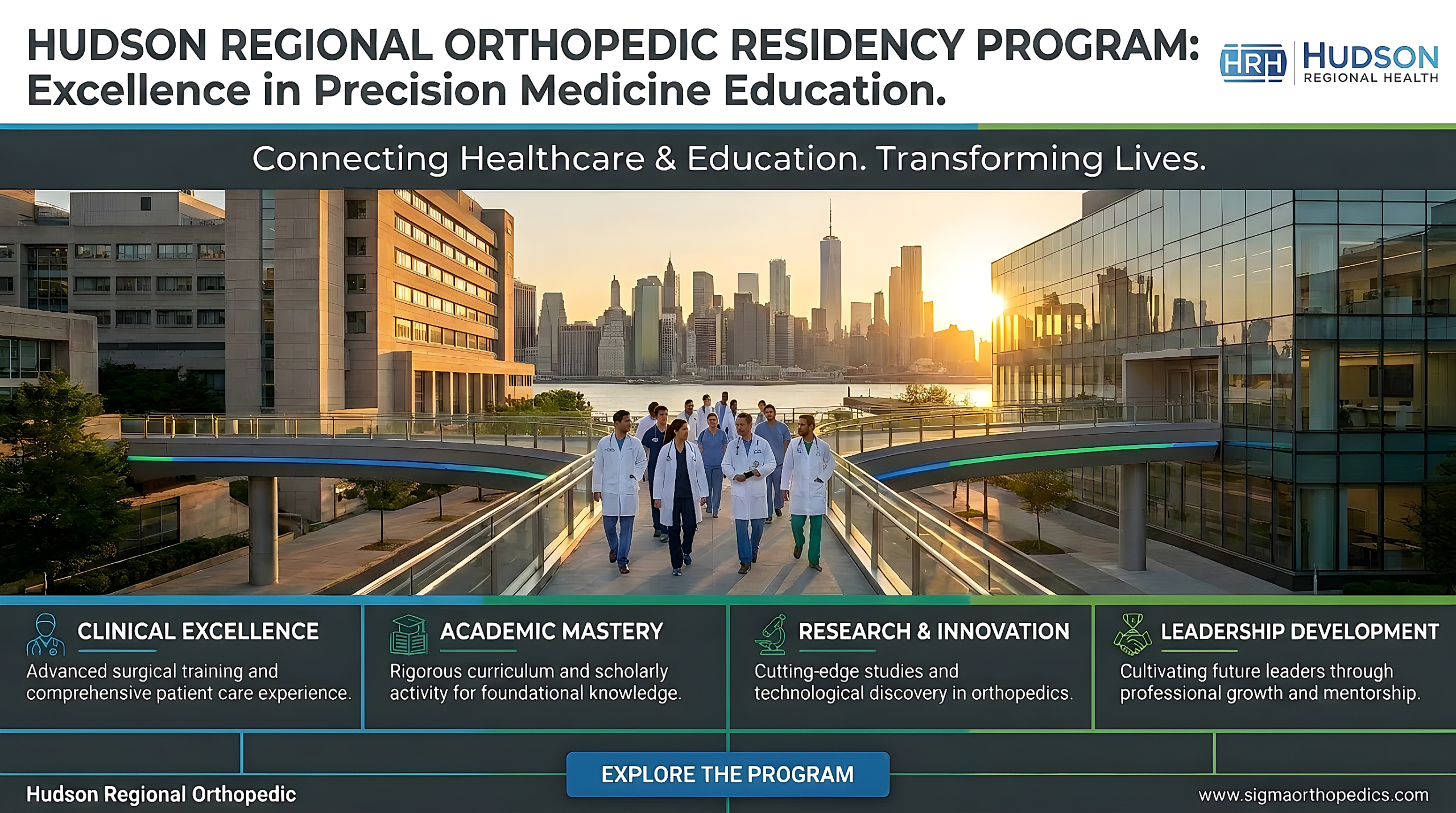
Built to Train Exceptional Orthopedic Surgeons

Our five-year curriculum combines an intensive foundation in general orthopedic surgery with progressive subspecialty training, graduated operative autonomy, structured simulation, longitudinal mentorship, and individualized career development.

Foundation → Mastery → Independence → Leadership
Hudson Orthopedics comprehensive training
The educational model

Four integrated pillars

Hudson Orthopedics is not simply a collection of rotations — it is a structured curriculum built to make residents successful on the OITE, ABOS boards, fellowship applications, and in independent practice.
Hudson Orthopedics surgical training

Clinical Excellence

  • Operative experience
  • Patient care
  • Decision making
  • Progressive responsibility

Academic Mastery

  • PASS
  • ROCK
  • OITE preparation
  • ABOS preparation
  • Structured didactics

Research & Innovation

  • Publications
  • National presentations
  • Outcomes research
  • Technology development

Leadership Development

  • Teaching
  • Professionalism
  • Mentorship
  • Healthcare systems
  • Practice management
Hudson Orthopedics residents in training
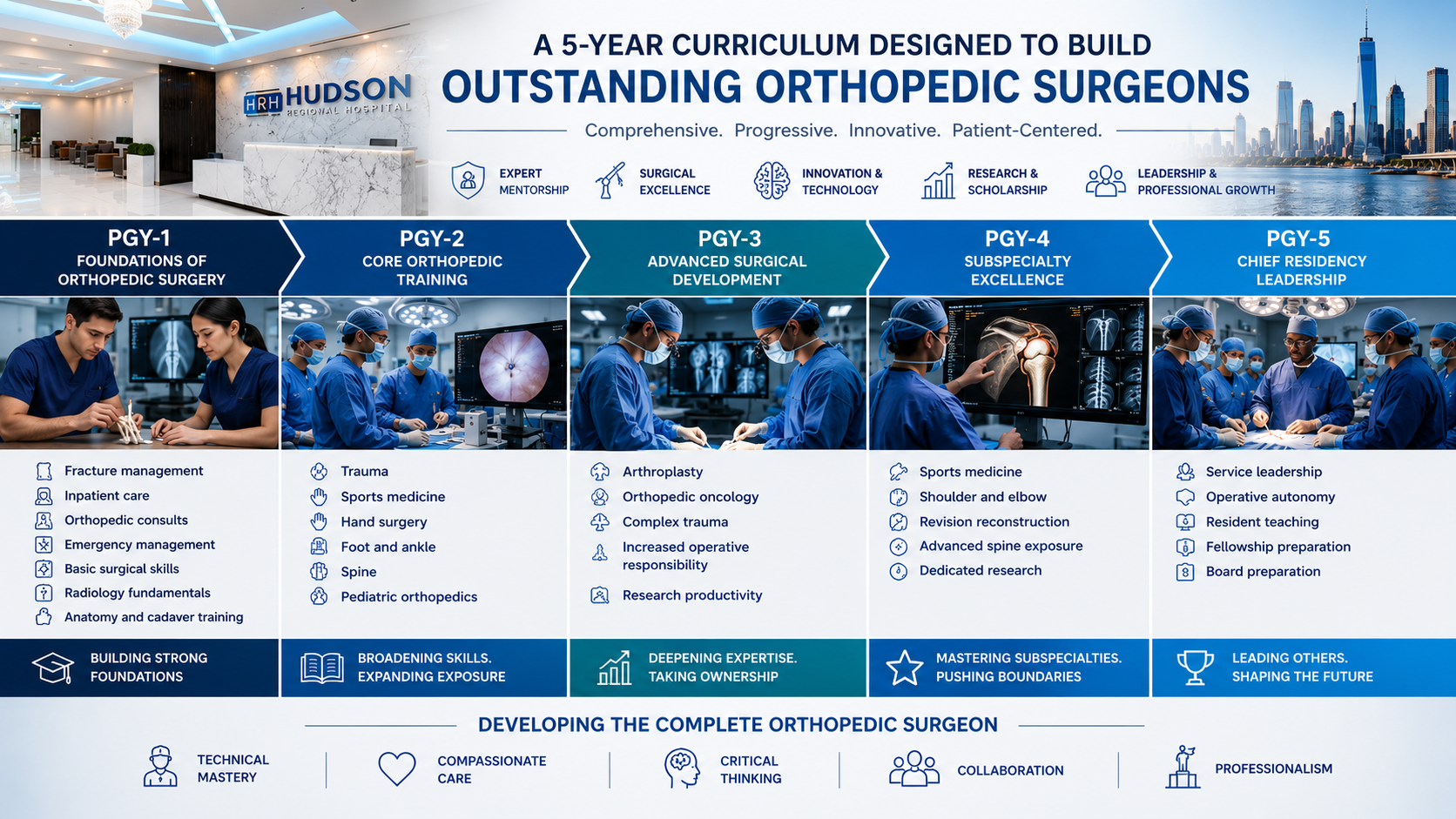
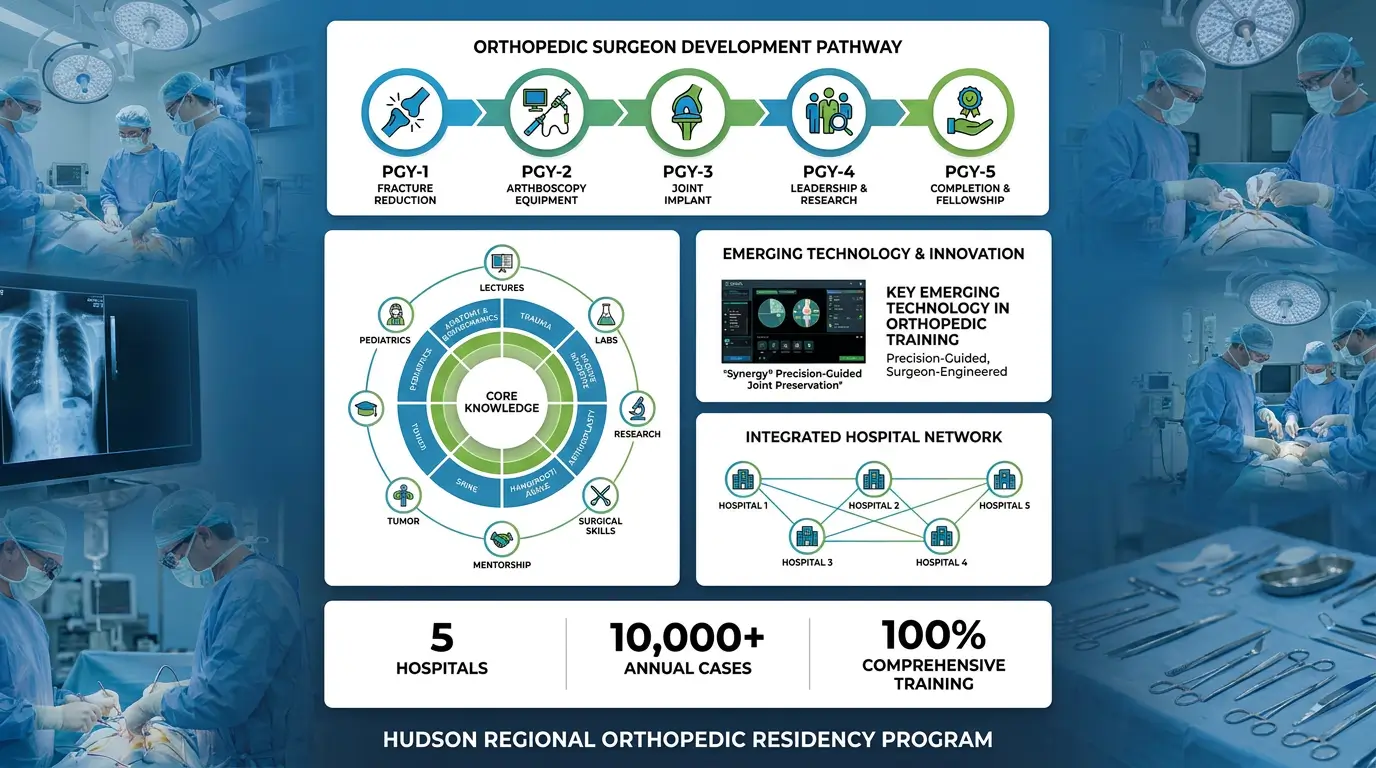
The five-year surgical journey

A structured roadmap, PGY-1 to PGY-5

Expand each year to see its focus, major rotations, and key educational milestones as residents progress from foundational skills to chief-level autonomy.

PGY-1Foundation+

The first year is designed to transform the medical school graduate into an orthopedic physician. Residents learn how to evaluate the injured patient, recognize urgent conditions, formulate a differential diagnosis, interpret imaging, perform essential procedures, prepare for surgery, and function effectively as members of the orthopedic team.

Months 1–2

Immersive Orthopedic Foundation

Direct supervision by Vincent McInerney, MD · assisted by Frank McCormick, MD

Core Focus
  • Orthopedic history and physical examination
  • Radiographic interpretation
  • Fracture description and initial management
  • Splinting and casting
  • Reductions
  • Sterile technique
  • Surgical positioning
  • Operating room workflow
  • Basic surgical approaches
  • Suturing and knot tying
  • Arthroscopy fundamentals
  • Clinic efficiency and documentation
  • Indications and surgical decision-making
Months 3–6

Foundational Surgical & Medical Rotations

These are not disconnected internship rotations — each is intentionally connected back to orthopedic practice:

Anesthesiology
Emergency Medicine
General Surgery
Critical Care
Radiology
PGY-2Core Orthopaedic Training+

Immersion across the core orthopedic subspecialties with growing operative participation and increasing confidence in the operating room.

Major Rotations
Sports Medicine & TraumaSpineAdult ReconstructionVascular Surgery
Key Educational Milestones
  • Core operative techniques
  • Diagnostic arthroscopy
  • Fracture fixation
  • Increasing operative responsibility
PGY-3Advanced Surgical Development+

Expanded operative responsibility and complex case exposure across subspecialties alongside rising research productivity.

Major Rotations
Foot & AnkleHand SurgerySpinePediatric Orthopaedics (Nemours)Orthopaedic Oncology & Trauma (Cooper)
Key Educational Milestones
  • Advanced arthroscopy
  • Cartilage restoration & orthobiologics
  • Pediatric & oncology experience
PGY-4Subspecialty Excellence+

Focused subspecialty depth, advanced surgical exposure, and dedicated scholarly work — the year of refinement.

Major Rotations
SpineAdult ReconstructionSports MedicineHand & Foot / Ankle
Key Educational Milestones
  • Complex reconstruction & arthroplasty
  • Advanced trauma
  • Resident teaching
  • Operative planning
PGY-5Chief Residency & Transition to Practice+

Service leadership and operative autonomy as residents prepare for fellowship, board examinations, and independent practice.

Major Rotations
TraumaSports MedicineAdult ReconstructionSpineFoot & Ankle
Key Educational Milestones
  • Operative autonomy & service leadership
  • Board preparation
  • Resident mentorship
  • Transition to independent practice

Responsibility is earned through demonstrated competence — not simply the passage of time.

Block rotation schedule

A color-coded view of all five years

Select any block to see the site, focus, and key surgical experiences. Schedule is representative and finalized with the ACGME application.

Placeholder — image for A Color-Coded View Of All Five Years
Sports Medicine Arthroplasty Trauma Oncology Pediatrics Spine / Hand / F&A Research Foundation / Off-service

Select a rotation block

Primary Experience

Key Surgical Experiences

Tip: select any block to see rotation details.

Rotation overview

Rotations across the five years

Distribution of core rotations across training levels. Final schedules follow ACGME requirements.

RotationPGY-1PGY-2PGY-3PGY-4PGY-5
General Orthopaedics / Surgical Skills····
Trauma / ED·
Sports Medicine··
Adult Reconstruction··
Spine·
Foot & Ankle··
Hand Surgery···
Pediatric Orthopaedics (Nemours)····
Orthopaedic Oncology (Cooper)····
Off-Service (Radiology, Anesthesia, etc.)····
Clinical training pathway

Progressive surgical responsibility

Residents develop technical skills and clinical judgment through a structured progression from supervised learning to independent decision making.

Foundation (PGY-1) Core Training (PGY-2) Advanced Skills (PGY-3) Subspecialty Excellence (PGY-4) Chief Resident (PGY-5)
Sports MedicineArthroplastyTraumaSpine Orthopedic OncologyPediatricsHandFoot & AnkleJoint Preservation
Research curriculum

Advancing orthopedics through discovery

Residents pursue scholarship across ten tracks, supported by faculty mentorship, dedicated academic time, and the SIGMA Outcomes & Performance Lab.
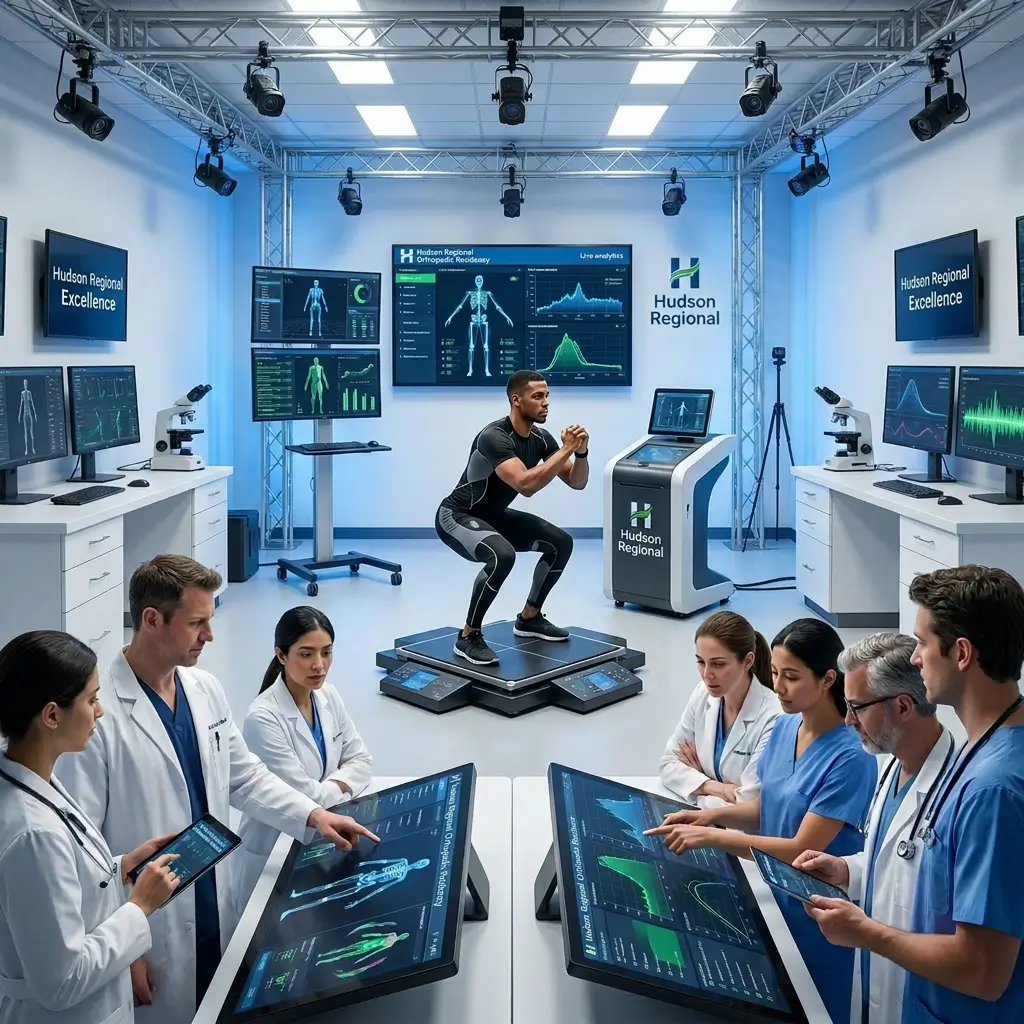
Sports MedicineJoint PreservationOrthobiologics Orthopaedic OncologyAI & Digital OrthopaedicsRobotics TraumaArthroplastyOutcomes ResearchHealthcare Innovation
Annual scholarly activity
National presentations
Publications
Research mentorship
Quality improvement projects
Hudson Orthopedics surgical education
Training sites

One residency. Five distinct training environments.

Residents rotate across a connected network of teaching hospitals and specialty centers throughout the greater New York metro region.
Placeholder — image to replace per Frank's comment 6
Academic home base

Bayonne Medical Center

General OrthopaedicsSports MedicineAdult ReconstructionTraumaSurgical Skills
Advanced orthopaedic surgery

Hudson Regional Hospital

Adult ReconstructionSpineSports MedicineAdvanced Orthopaedic Surgery
Community orthopaedics

Hoboken University Medical Center

General OrthopaedicsHand SurgeryFoot & AnkleCommunity Orthopaedics
Pediatric rotation

Nemours Children's Health

Pediatric Orthopaedic SurgeryFracturesScoliosisDeformity correctionHip disorders
Level I Trauma Center · Oncology

Cooper University Hospital

Orthopaedic TraumaOrthopaedic OncologyPolytraumaPelvis & AcetabulumComplex fractures
One of a select number of Level I trauma centers in New Jersey
Didactic curriculum

A structured orthopedic education

Clinical excellence begins with educational excellence — anchored by nationally recognized learning platforms and longitudinal board preparation.

Placeholder — image to replace per Frank's comment 5
PASS

Program for the Advancement of Surgical Skills

A comprehensive orthopedic educational framework aligned with residency milestones and board preparation, used throughout training.

  • Core orthopedic knowledge
  • Clinical decision making
  • Case-based learning
  • Surgical planning
  • OITE preparation
  • ABOS preparation
ROCK

Resident Orthopedic Core Knowledge

A foundational educational platform structuring weekly orthopedic resident learning and self-assessment.

  • Weekly assignments
  • Reading curriculum
  • Self-assessment
  • Core topic review
  • OITE preparation
  • Milestone tracking
OITE

In-Training Examination Preparation

Structured longitudinal preparation beginning in PGY-1 to maximize resident performance and board preparedness.

  • Weekly question review
  • Monthly testing
  • Faculty review sessions
  • PASS integration
  • ROCK integration
  • Board review conferences
ABOS

Board Preparation

Structured preparation for ABOS Part I and Part II, built around mentorship and realistic practice examinations.

  • Case review
  • Oral board simulation
  • Faculty mentorship
  • Practice examinations
  • Part I readiness
  • Part II readiness
Weekly educational conferences

A protected, predictable teaching week

MONDAY

Sports Medicine

  • Faculty case review
  • Journal discussion
TUESDAY

Fracture Conference

  • Trauma indications
  • Case review
  • Radiology review
WEDNESDAY

Grand Rounds

  • Visiting professors
  • Faculty lectures
  • Research presentations
THURSDAY

PASS / ROCK

  • Board review
  • Interactive cases
  • OITE preparation
FRIDAY

M&M Conference

  • Quality improvement
  • Complication review
  • Professional development
Monthly educational experiences

Recurring deep-dives & hands-on learning

Journal Club & Evidence-Based Medicine
Tumor Board
Cadaveric Surgical Skills Laboratory
Arthroscopy & Bioskills Simulation
Sawbones Fracture Lab
Research & Innovation Curriculum
Visiting Professor Series
Quality Improvement & Patient Safety
Board Review Sessions
Longitudinal curriculum

Woven through all five years

Beyond rotations and conferences — twelve longitudinal threads run continuously from PGY-1 through graduation.

Human Performance Laboratory
AI & Digital Orthopaedics
Orthobiologics & Regenerative Medicine
Clinical Trials & Outcomes Research
Cadaveric Surgical Skills Lab
Arthroscopy & Bioskills Simulation
Journal Club & Evidence-Based Medicine
Board Preparation Curriculum
Leadership & Resident Teaching
Quality Improvement & Patient Safety
Research & Innovation Curriculum
Wellness & Resident Support
Simulation curriculum

Practice before performance

Residents build technical fluency in a low-stakes environment before translating skills to the operating room.

Arthroscopy Simulation

Fracture Fixation Labs

Sawbones Training

Cadaveric Surgical Skills

Ultrasound Training

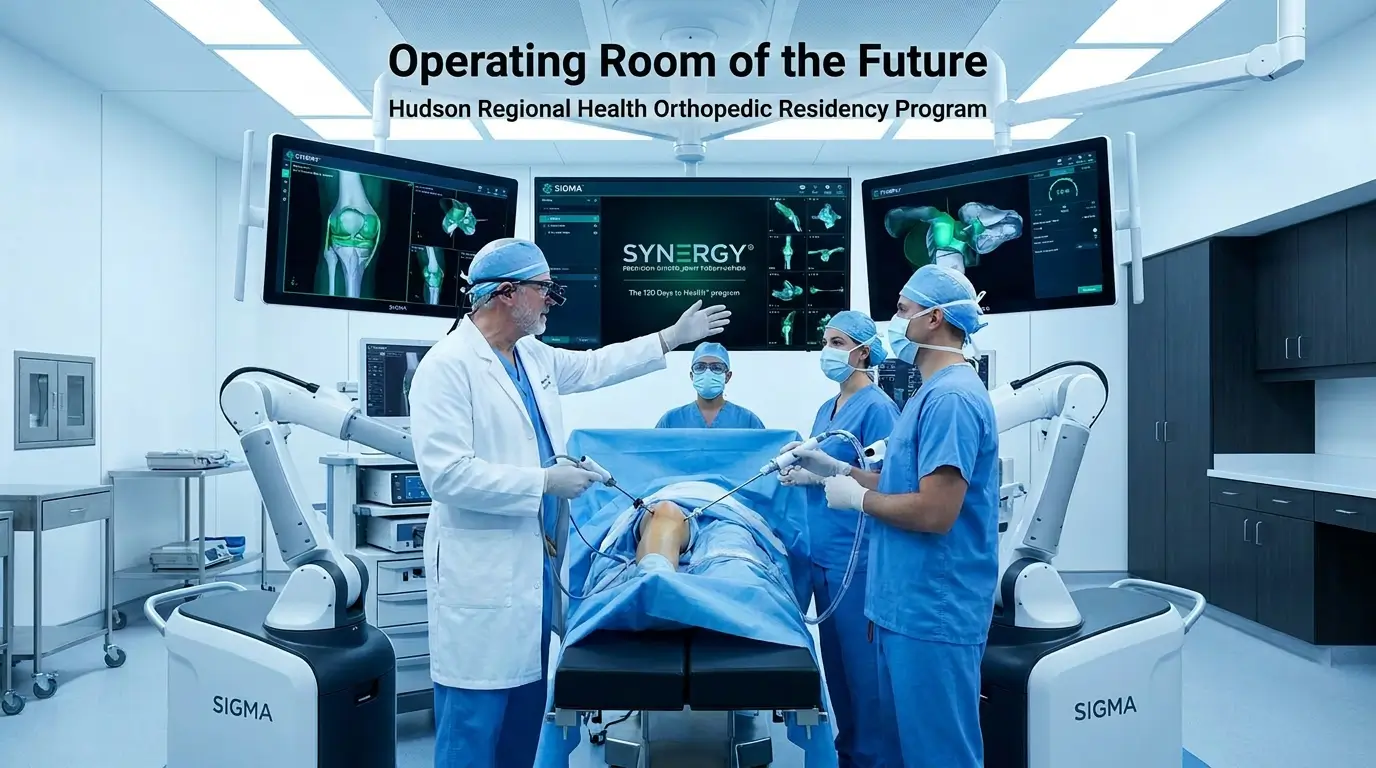
Robotic Surgery Exposure

Surgical Planning Workshops

Emergency Ortho Simulation

Hands-on training

Surgical skills development program

Residents participate in dedicated, hands-on surgical skills training throughout the program — building technical proficiency outside the operating room.

Cadaver laboratories
Arthroscopy simulation
Fracture fixation workshops
Ultrasound-guided procedures
Orthobiologic injection training
Surgical anatomy sessions
Industry-sponsored technology labs
Breadth of training

Comprehensive orthopaedic exposure

Residents receive training across the full breadth of orthopaedic subspecialties throughout their five years.

01Sports Medicine
02Shoulder & Elbow
03Trauma
04Adult Reconstruction
05Hand Surgery
06Foot & Ankle
07Spine Surgery
08Pediatric Orthopaedics
09Orthopaedic Oncology
10Orthobiologics & Joint Preservation

Residents progress from foundational exposure to increasingly advanced subspecialty experiences across the five-year curriculum, with senior electives supporting individualized career goals and fellowship preparation.

Leadership curriculum

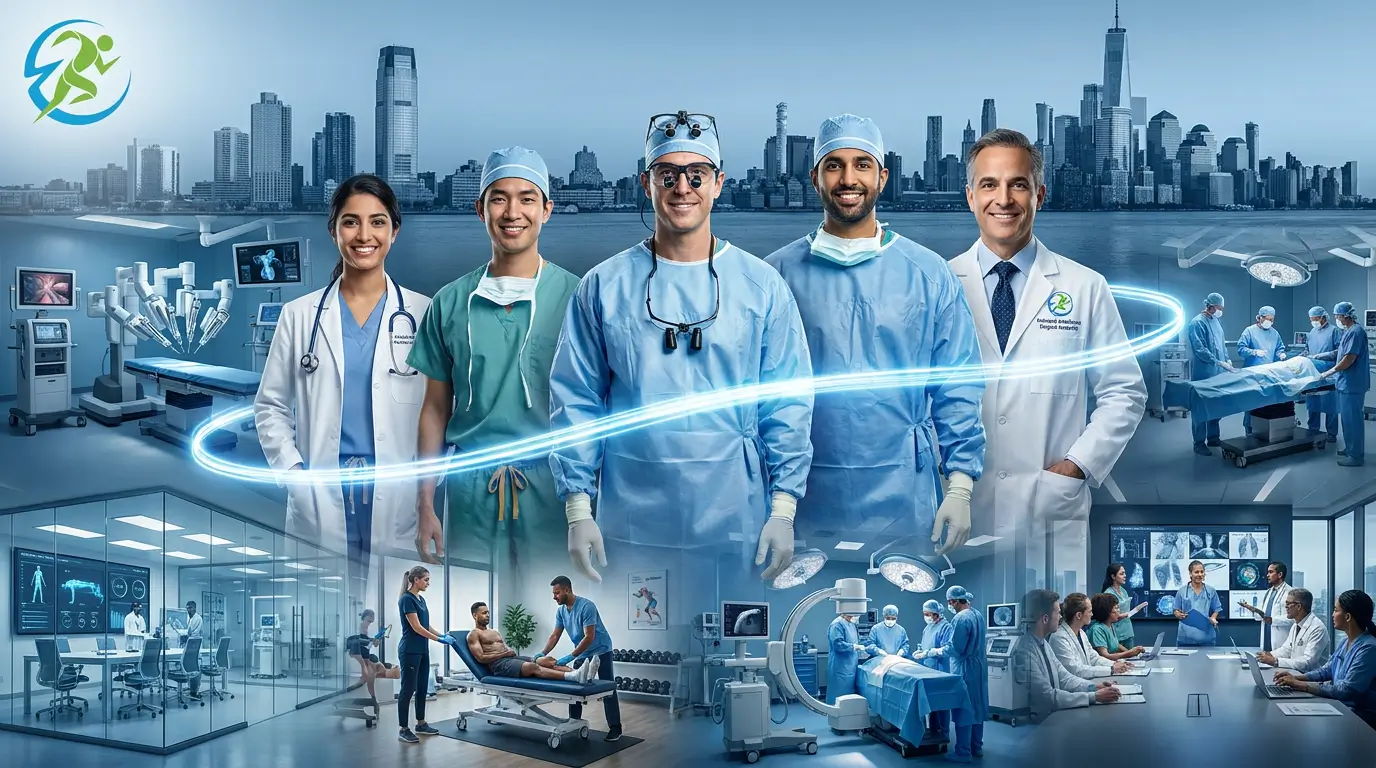
Developing future leaders

A defining Hudson differentiator — deliberate leadership training woven through all five years of training.
Communication
Team Leadership
Professionalism
Teaching Skills
Practice Management
Healthcare Systems
Quality Improvement
Resident Mentorship
Public Speaking
Career Planning
Wellness & resident support

Supported at every stage

  • Faculty mentorship
  • Peer mentorship
  • Academic coaching
  • Mental health resources
  • Wellness activities
  • Resident retreats
  • Professional development
Fellowship & career development

A clear path to your next step

  • Dedicated faculty advisors & annual career planning
  • Mock interviews & research portfolio review
  • Sports, Arthroplasty, Trauma, Spine, Oncology
  • Hand, Foot & Ankle fellowships
  • Academic & private practice pathways
  • Military medicine & industry tracks
Placeholder — image to replace per Frank's comment 7
Graduation competencies

What every Hudson graduate achieves

Graduates of the Hudson Regional Orthopaedic Surgery Residency will possess the clinical judgment, technical proficiency, professionalism, leadership skills, research literacy, and innovative mindset necessary to excel in fellowship training or independent practice.

Exceptional Clinicians

Clinical judgment and decision-making across all orthopaedic subspecialties

Skilled Surgeons

Technical proficiency built through high-volume, progressive operative experience

Innovative Thinkers

Research literacy, technology fluency, and the ability to advance the specialty

Compassionate Leaders

Professionalism, mentorship, and a commitment to patient-centered care

Training Tomorrow's Orthopaedic Leaders. Innovating Today. Transforming Lives.

Your orthopaedic education starts here

Five years of structured training

One lifetime of impact.